When the lights go out, a reliable backup generator isn't just a luxury—it's peace of mind, protecting your home, family, or business from disruption. But with so many options on the market, understanding the Generac Generator Cost Comparison with Competitors becomes a mission-critical step in making the right investment. Generac has long been a household name in home backup power, but how does their value stack up against the robust offerings from Kohler, Cummins, Briggs & Stratton, and others?
Choosing the right generator means looking beyond the sticker price. It's about total cost of ownership, performance under pressure, and the assurance that when you need power most, it’s there. Let's cut through the noise and illuminate what truly matters.
At a Glance: Your Generator Cost Cheat Sheet
- Generac Dominance: Commands approximately 40% of the residential standby market, known for broad range and extensive dealer network.
- Cost Drivers: Initial purchase price is just one piece; factor in installation, fuel, maintenance, and warranty for a true total cost of ownership (TCO).
- Premium Alternatives: Kohler and Cummins often come with higher upfront costs but offer superior power quality, quieter operation, and enhanced durability.
- Value-Oriented Choices: Briggs & Stratton and Champion provide strong features at competitive price points, appealing to budget-conscious buyers.
- Portable vs. Standby: Portable generators are significantly cheaper but offer less convenience and automation than home standby units.
- Key Comparison Criteria: Evaluate brands on performance, reliability, fuel options, noise, smart features, and service network.
Generac: The Pioneer and The Benchmark
Generac, founded in 1959, didn't just join the backup power market; they largely shaped it. They pioneered affordable home standby generators in the 1980s, making automated backup power accessible to millions. Today, Generac is a leader across portable, inverter, and home standby units, boasting a vast portfolio that includes automatic transfer switches (ATS) and remote monitoring tools like Mobile Link™. With around 40% of the residential standby generator market, Generac often sets the standard against which competitors are measured.
Their strengths lie in wide retail availability, a massive dealer and service network, and a diverse product range that fits almost any residential need. However, as we dive into a cost comparison, it’s important to note that while Generac offers a solid all-around package, specific competitors might edge them out in niche areas like ultra-quiet operation, cold-weather performance, or superior power quality.
Beyond the Sticker Price: Unpacking the Real Cost of a Generator
When you consider a generator, whether it's for emergency backup or continuous power, the purchase price is only one part of the equation. To truly understand the Generac generator pricing and how it stacks up against competitors, you need to factor in the total cost of ownership (TCO).
Here’s what goes into that calculation:
1. Initial Purchase Price (The Generator Unit Itself)
This is the most obvious cost. It varies wildly based on:
- Type: Portable, inverter, or home standby. Portable units are the cheapest, while large home standby systems are the most expensive.
- Power Output (kW): A 22kW standby generator will cost significantly more than a 10kW unit.
- Features: Automatic transfer switches (ATS), remote monitoring, load management, and advanced enclosures add to the base price.
- Fuel Type: While often similar, diesel units can sometimes be more expensive initially than natural gas or propane models due to engine complexity.
2. Installation Costs
For home standby generators, installation is a major expense, often equalling or even exceeding the generator's purchase price. This includes:
- Site Preparation: A concrete pad or stable base for the unit.
- Electrical Work: Connecting the generator to your home's electrical system, including the crucial automatic transfer switch (ATS). This often requires a licensed electrician.
- Fuel Line Installation: Running a natural gas line from your meter or installing a large propane tank and connecting it. This requires a licensed plumber or gas fitter.
- Permits and Inspections: Local regulations dictate what permits are needed, adding time and cost.
- Ancillary Equipment: Battery, wiring, conduit, etc.
Understanding typical installation costs is crucial for accurate budgeting. Understanding typical installation costs can help you prepare for this significant part of your investment.
3. Fuel Costs
This is an ongoing expense that fluctuates with market prices and usage.
- Natural Gas: Generally the most cost-effective for continuous use, as it’s piped directly to your home and doesn't require refueling.
- Propane: Stored in a tank, offering good efficiency, but requires regular refills for extended outages. Prices can be volatile.
- Diesel: Excellent for long-term storage and high-demand applications, but diesel units themselves are often more expensive, and fuel can be pricier.
Your choice of fuel type, coupled with how often and how long you expect to use your generator, will significantly impact your long-term operating expenses.
4. Maintenance and Servicing
Like any engine, generators need regular maintenance to ensure they perform reliably when called upon. This typically includes:
- Annual Tune-ups: Oil changes, filter replacements, spark plug checks.
- Load Bank Testing: Periodically running the generator under a full load to ensure all components are functioning correctly.
- Battery Replacement: Batteries usually need replacing every 3-5 years.
- Emergency Repairs: Unexpected issues can arise, especially without regular maintenance.
Many manufacturers, including Generac, recommend professional servicing to maintain warranty validity. Neglecting essential generator maintenance can lead to costly repairs down the line.
5. Warranty and Extended Coverage
Standard warranties vary by manufacturer and model (typically 2-5 years for parts and labor). Extended warranties are available but add to the upfront cost. Factor in the cost of potential repairs outside the warranty period.
The Generac Cost Landscape: What to Expect
Generac offers a spectrum of generators, each with different price points and intended uses.
- Generac Portable Generators:
- Price Range: $500 - $3,000+
- Capacity: 1,500W to 17,500W
- Ideal For: Tailgating, camping, job sites, and essential circuits during short power outages. Easy to move, manually started, and require refueling.
- Cost Factor: Significantly lower initial cost, but manual operation and fuel management required.
- Generac Inverter Generators:
- Price Range: $800 - $4,000+
- Capacity: 1,700W to 4,500W
- Ideal For: Powering sensitive electronics, camping, and quieter backup needs. They produce clean power and are more fuel-efficient and quieter than conventional portables.
- Cost Factor: Higher than conventional portables, but offer better fuel economy and user experience.
- Generac Home Standby Generators:
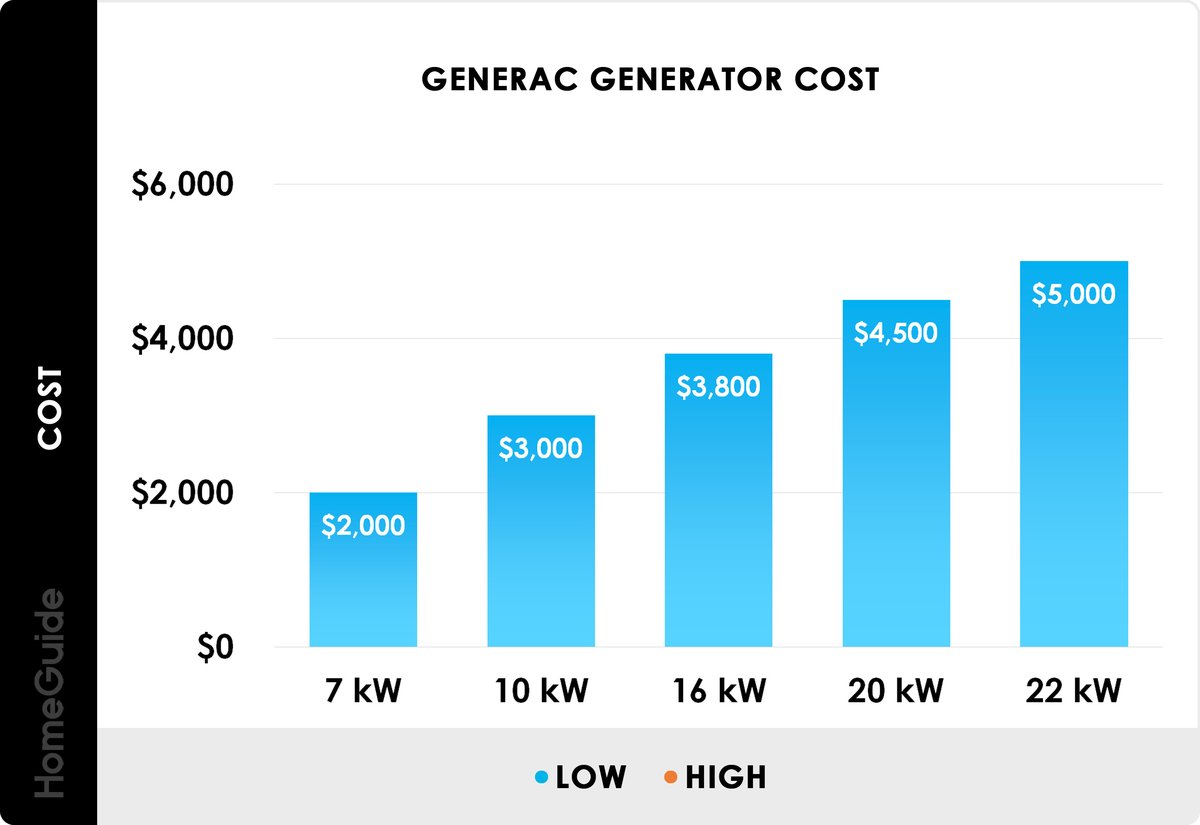
- Price Range (Unit Only): $3,000 - $15,000+
- Capacity: 7kW to 26kW (residential), larger for commercial.
- Ideal For: Automatic, whole-home or essential circuit backup during extended power outages. Runs on natural gas or propane, with automatic transfer switches.
- Cost Factor: Highest initial purchase and installation costs, but offer the ultimate convenience, reliability, and automation. This is where the bulk of the cost comparison with competitors will lie.
- Example: A popular 22kW Generac Guardian unit might cost around $5,500 - $6,500 for the unit itself, with total installed costs ranging from $10,000 to $15,000+.
Generac vs. The Titans: A Head-to-Head Cost & Value Showdown
Now, let's pit Generac against its main rivals, examining both cost and the underlying value propositions.
1. Generac vs. Kohler
Kohler holds about 25% of the residential market, positioning itself as a premium alternative. They are recognized for robust engineering, refined design, and quiet operation.
- Generac Cost & Value: Typically offers a slightly lower initial purchase price for comparable kW output. Generac excels in broad model availability and its extensive dealer network, often making parts and service readily accessible.
- Kohler Cost & Value: Generally comes with a higher initial purchase cost (often 10-20% more than Generac for similar capacity). However, Kohler justifies this with:
- Superior Power Quality: Minimal harmonic distortion (<5% THD), crucial for sensitive electronics.
- Quiter Operation: Corrosion-resistant enclosures and thoughtful design contribute to significantly lower decibel levels.
- Faster Response Time: Industry-leading 5-second response time when power is lost.
- Commercial-Grade Components: Often uses heavier-duty components, hinting at longer lifespan and durability.
- Ideal For: Homeowners prioritizing quality, longevity, and quiet operation in harsh environments, willing to pay a premium for these benefits.
- Trade-off: The higher upfront cost is the primary barrier for some, though many find the long-term value justifies it.
2. Generac vs. Cummins
Cummins brings industrial-grade credibility to residential and commercial standby power, trusted in mission-critical environments. They hold approximately 15% of the residential market.
- Generac Cost & Value: As noted, Generac offers a more budget-friendly entry point and a wider network.
- Cummins Cost & Value: Typically has the highest initial purchase price among top residential brands, often 20-30% higher than Generac for equivalent output. This premium reflects:
- Industry-Leading Durability: Designed for extreme environments and long runtimes.
- Excellent Cold Weather Performance: Reliably starts at -22°F, a critical advantage in colder climates.
- Quietest in Class: Often operates as low as 62 dB, making it one of the quietest options available.
- Superior Power Quality: Less than 2% harmonic distortion, making it exceptionally safe for the most sensitive electronics.
- Global Support: Unparalleled support network, especially for larger commercial units.
- Ideal For: Users valuing absolute uptime, extreme reliability, serviceability, and long-term durability in challenging conditions, where initial cost is secondary to performance.
- Trade-off: Highest initial purchase cost and a more limited residential dealer network compared to Generac.
3. Generac vs. Briggs & Stratton
Briggs & Stratton is a familiar name, holding about 20% of the market, targeting homeowners seeking dependable backup without premium price tags.
- Generac Cost & Value: Generally positions itself slightly above Briggs & Stratton in price for similar kW output, offering a larger feature set on some models and a broader range.
- Briggs & Stratton Cost & Value: Offers very competitive pricing, often a bit lower than Generac, making it attractive to budget-conscious buyers. Key value points include:
- Value-Oriented Pricing: Strong feature sets for the price.
- Symphony® II Power Management: Allows smaller units to cover more circuits by intelligently managing high-demand appliances, potentially reducing the overall generator size needed (and thus cost).
- In-house Engines: A long history of engine manufacturing.
- Compact Footprints & Quiet Operation: Though generally slightly noisier than premium brands like Kohler or Cummins, they are still designed for residential areas.
- Ideal For: Budget-conscious homeowners and small offices needing reliable backup for essentials, who appreciate smart power management features.
- Trade-offs: Slightly higher noise levels than premium brands and shorter standard warranty on some models, though extended options are available.
4. Generac vs. Caterpillar (CAT)
Caterpillar dominates large-scale power systems. While Generac offers commercial units, CAT's primary focus is on high-demand, mission-critical applications where uptime is paramount.
- Generac Cost & Value: More accessible for light commercial or larger residential needs, with more localized dealer support for these segments.
- CAT Cost & Value: Typically the highest acquisition cost, with longer lead times, especially for custom configurations. However, for large-scale applications, CAT provides:
- Unmatched Durability & Longevity: Designed for continuous operation in the harshest industrial settings.
- Robust Electrical Performance: Ideal for complex load requirements (diesel/gas options).
- Turnkey Solutions: Via their extensive global Cat dealer network, offering comprehensive project management.
- High Resale Value: Known for retaining value due to their build quality.
- Ideal For: Industrial facilities, hospitals, data centers, and organizations needing to standardize across multiple large sites. Not typically a direct residential competitor.
- Trade-off: The significant upfront investment and lead times make it unsuitable for most residential or small business needs.
5. Other Notable Competitors and Their Niches
While the above are Generac's main rivals in the home standby space, other brands excel in specific segments:
- Honda & Yamaha: Market leaders in premium portable inverter units. Unmatched for ultra-reliable, clean power output, exceptional fuel efficiency, and whisper-quiet operation. Not major players in home standby, but excellent for portable needs where the benefits of remote monitoring might be less critical than portability and quiet.
- Champion Power Equipment: A rapidly growing brand known for delivering feature-rich portable and standby generators at competitive prices. They offer dual fuel capability and modern conveniences, making them a strong value proposition.
- Westinghouse: Popular for portable and inverter generators, focusing on affordability and user-friendly features like remote start and CO sensors. Strong in big-box retail but fewer dealer-installed standby options.
- DuroMax: Has carved a niche with powerful, feature-packed portable and dual fuel generators, focusing on high wattage output for maximum power per dollar. Louder than premium inverters but robust.
- Atlas Copco & MTU Onsite Energy (Rolls Royce Power Systems): Primarily industrial/commercial players, specializing in mobile power solutions (Atlas Copco) or high-performance, mission-critical gensets (MTU) where customization and extreme reliability outweigh price sensitivity. These are not direct residential competitors for Generac but represent the top tier of industrial power generation.
Key Criteria for Your Generator Investment: Making an Informed Choice
Beyond brand and initial cost, making the best decision for your specific needs requires a closer look at several technical and practical criteria. This framework will help you compare Generac and its rivals effectively.
1. Performance and Sizing
- Continuous vs. Surge Power: Does the generator provide enough running watts for your everyday needs and sufficient surge watts to start heavy appliances (AC units, well pumps)? Don't just pick a number; sizing your generator correctly for your specific load is crucial.
- Voltage Stability & Total Harmonic Distortion (THD): Standby generators generally offer excellent voltage stability. For sensitive electronics, aim for <5% THD. Premium brands like Kohler and Cummins often boast <2% THD, while some entry-level units might be higher.
2. Reliability and Engine Quality
- Duty Rating: Is the engine designed for intermittent backup or continuous prime power? Most home standby units are for intermittent use.
- Cold Weather Starting: Does it have features like an engine block heater for reliable starts in freezing temperatures? Cummins excels here.
- Load Acceptance: How quickly does the generator respond when power is lost and a load is applied? Kohler's 5-second response is industry-leading.
- Maintenance & Parts Availability: Consider the ease of maintenance and how readily available spare parts are. Generac's vast network is a strength here.
3. Fuel Options and Efficiency
- Natural Gas, Propane, Diesel, or Bi-fuel: Each has pros and cons for cost, storage, and availability. Exploring different fuel options is essential for long-term cost-effectiveness.
- Consumption Rates: How much fuel does it consume per hour at various load levels? More efficient generators save money over time.
- Emissions: While generally not a primary residential concern, emissions can be a factor in some regions or for commercial applications.
4. Noise and Installation Flexibility
- Decibel Ratings: Generators are noisy. Check the dB(A) rating at a specific distance (e.g., 23ft). Lower is better. Cummins and Kohler are often lauded for quieter operation.
- Enclosure Design: Weatherproof and sound-attenuated enclosures protect the unit and reduce noise.
- Footprint & Clearance: Ensure you have enough space and adhere to local codes for placement, especially concerning proximity to windows, doors, and property lines.
5. Smart Features and Ecosystem
- Remote Monitoring: Features like Generac's Mobile Link™ allow you to monitor your generator's status, fuel levels, and maintenance needs from your smartphone or computer.
- Automatic Transfer Switch (ATS): Essential for home standby, ensuring seamless power transition.
- Load Management: Systems like Briggs & Stratton's Symphony® II prioritize power to essential appliances, allowing you to cover more with a smaller (and cheaper) generator.
- Integration with Solar/Storage: For future-proofing, consider units that can integrate with existing or planned solar panels and battery storage.
6. Service, Warranty, and Dealer Network
- Labor/Parts Coverage: Understand what's covered and for how long.
- Authorized Service Reach: How far away is an authorized dealer or service technician? Generac's large network often means quicker response times.
- Response Times: During widespread outages, how quickly can your dealer respond for maintenance or repairs? This is where a robust network truly shines.
7. Availability and Lead Times
- Stock Levels: Are units readily available, or are there long wait times? Supply chain issues can impact availability, especially for popular models.
- Shipping Timelines: Factor in delivery time to your installer.
- Emergency Response: For critical needs, inquire about expedited options.
Navigating the Purchase: Tips for Finding the Best Deal
You've done your research on Generac Generator Cost Comparison with Competitors, understood the TCO, and weighed the pros and cons. Now, how do you actually get the best value?
- Get Multiple Quotes: Don't settle for the first estimate. Contact 2-3 authorized dealers for your preferred brands. Ensure quotes are itemized, covering the generator, ATS, installation, permits, and any accessories.
- Factor in Installation & Permits: This is often the most variable part of the cost. A complex installation (long gas lines, difficult electrical runs) can significantly drive up expenses. Understand exactly what's included in the installation quote.
- Understand Warranties: A longer or more comprehensive warranty can save you significant money on repairs down the line. Compare standard warranties and the cost of extended coverage.
- Consider Financing Options: Many dealers and manufacturers offer financing plans, spreading the cost over several months or years. Evaluate interest rates and terms carefully.
- Look for Promotions: Keep an eye out for seasonal sales, manufacturer rebates, or dealer specials, especially during off-peak seasons (not right before hurricane season).
- Don't Underestimate Maintenance Plans: While an added upfront cost, a service contract can ensure your generator is always ready, potentially extending its lifespan and avoiding costly emergency repairs.
Common Questions About Generator Costs
Why are standby generators so expensive?
Standby generators are complex machines. Their cost reflects the robust engine, alternator, weather-resistant enclosure, sophisticated control board, and the automatic transfer switch (ATS) required for seamless, automated operation. Installation also adds significant cost due to the need for professional electrical and gas line work, along with permits.
Can I install a generator myself to save money?
For home standby generators, self-installation is generally not recommended and often illegal without proper licensing. Electrical and gas line connections are dangerous and require specific expertise and permits. Improper installation can void warranties, pose safety hazards, and lead to costly code violations. Portable generators are plug-and-play, but standby units are a professional job.
What's the best fuel type for cost-efficiency?
For home standby use, natural gas is often the most cost-efficient in the long run because it's continuously supplied by a utility and generally has lower and more stable prices than propane. Propane requires a tank and refills, adding logistical costs. Diesel is typically the most expensive fuel but offers excellent power density and storage stability.
Does a larger generator always cost more to run?
Not necessarily. While a larger generator might consume more fuel at maximum load, it also operates more efficiently when it's not straining. An undersized generator that constantly runs at its limits might be less efficient and experience more wear and tear than a slightly larger unit that comfortably handles the load. Choosing the right size is about balancing upfront cost with long-term efficiency and durability.
Your Next Steps: Powering Your Peace of Mind
Navigating the world of backup power, from understanding Generac Generator Cost Comparison with Competitors to evaluating specific features, can seem daunting. But armed with this comprehensive guide, you’re now equipped to make an informed decision.
Remember, the "best" generator isn't about the lowest price tag; it's about the best value for your specific needs, balancing upfront costs with long-term reliability, fuel efficiency, maintenance, and the peace of mind that comes from knowing your power source is dependable. Start by assessing your power requirements, consider your budget for both purchase and installation, and then reach out to local authorized dealers for detailed quotes. Your perfect power solution is within reach.
Untuk pemahaman lebih lengkap, baca panduan utama kami: Generac generator pricing